Many of you will have found yourself in the situation of having to conduct a “stringendo” or “accelerando”.
Initially, it is most likely that you will have experienced the feeling of wanting to move the orchestra forward, but to no avail and to have felt a mass of sound under your hands, that is difficult to push forward from the speed in which they play.
Generally in these situations, a beginner starts to beat the beats more quickly little by little, but without getting great results.
The conductor loses contact with the orchestra, which after a while may no longer be able to follow his waving and bouncing from one beat to the next and it could find itself at least one bar out. In the realisation of a stringendo (as with an allargando), it is instead, extremely important to show its continuity and evolution in tempo.
Therefore, as easily seen in the video, it is understandable that we must gradually increase the speed of gesture almost imperceptibly, but at the same time, preserve contact with the sound, because in the third phase of the attack, a sudden push of the beat with the hand upwards into the air, would lose contact with the sound.
In fact in not having contact with the sound during the rise, the orchestra would remain behind and the conductor, unbalanced and ahead. (For those who have not read the previous articles, a reminder that there are 3 phases of attack, namely ascent - fall - rise - during the third, one has contact with the sound)
As can be observed clearly in the following video, by paying close attention you will notice how the contact with the sound takes place at the moment of the "rise" of the arm upwards; the third phase of the attack:
The same passage with orchestra:
However it should also be pointed out that many stringendos can be realised by using the principle of the circular gesture.
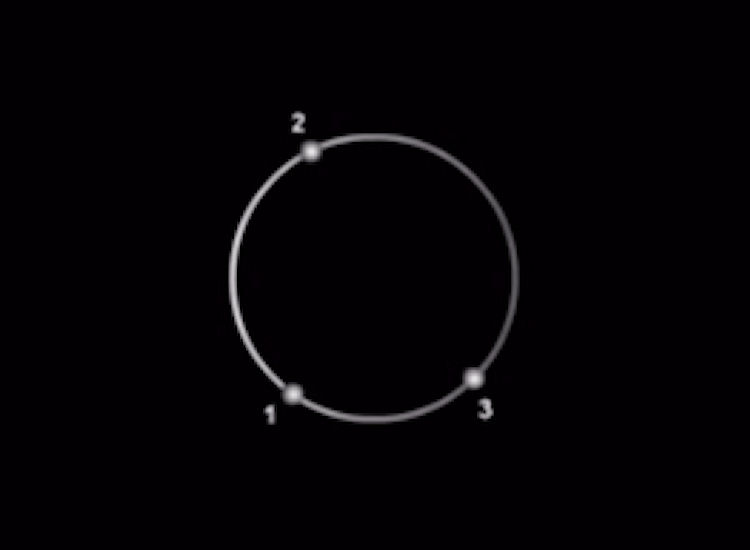
Once we find ourselves in a circular gesture for triple time, we know that the circle is the only geometric figure exactly divisible into three and it enables you to smoothly and gradually increase the speed whilst maintaining the arrangement of beats within the circle and therefore, to relatively simply effect the stringendo.
In the following image (from the book / DVD " introduction to orchestral conducting technique” edition Curci Milano),
you see the exact layout of the beats within the circular gesture for triple time.
Do you feel you have no control on the orchestra, not able to move it and take it where you want? Do you feel it is not together as you conduct and you are forced to follow it?
The problem, my friend, is that you don’t have a complete technique.
How do I know? Simple: I’ve been there, and before you. But one day I found a way to change things up once and for all…